Safe AI where people are most vulnerable
In schools, hospitals, public offices and social services, AI can free time and attention for people. But there an error reaches a student, a patient, a citizen. That is why it is used only within an ethical and safe framework, written in advance, with people first. Here are the measures it takes. I help schools, public bodies and organisations put them into practice.
Last step: confirm your email
Your message reaches me straight away. The link I send you by email confirms the sign-up: without the click you get no further emails. If it does not arrive, check your spam folder.
Why are schools, hospitals and public bodies sensitive settings for AI?
For three reasons. The people involved often cannot choose: a student does not choose the school, a patient does not choose the ward, a citizen does not choose the office. The data are among the most protected: health, minors, social and economic conditions. And decisions weigh on people's lives: a mark, a diagnosis, access to a service. The law recognises this too: the European AI Act treats many uses in education and in access to essential public services as high-risk, and the GDPR gives health data special protection.
What can AI offer in these settings?
Time and attention given back to relationships. Fewer hours on paperwork (minutes, forms, summaries, letters), more hours with people. Materials adapted to different needs. Clearer information for anyone finding their way through a service. The potential is real, but it only comes out if the machine stays a tool in the hands of those who care for people, and does not take their place.
What does it take to use AI safely?
Rules written in advance, not trust. No rule brings the risk to zero: it reduces it and helps catch errors before they do harm. These are the measures I consider necessary.
- Start from people, not from the tool. Before choosing any software, write down who is affected, what can go wrong and for whom. Where the law requires it, carry out an impact assessment on data and on people's rights.
- Decisions about people stay human. A mark, a diagnosis, a benefit, a case: AI can prepare material, not decide. Whoever signs has read the material, understood the reasoning and can explain the decision.
- Sensitive data stay out of general-purpose tools. No names, diagnoses or stories of students, patients and service users in a public chat. Only the data that are needed; names become codes, and the tables that link them back to people stay in an internal archive. Pseudonymising is not anonymising: content can also identify someone, which is why documents with health data or data about minors stay out.
- A closed space and minimal permissions. Tools chosen and configured by the organisation, with clear contracts on where the data end up. Each function is switched on only if needed; passwords never pass through the machine.
- Nothing goes out without a human yes. Emails, messages to families, letters to citizens: AI prepares the draft, a person reads it and sends it. Before deleting anything, a copy.
- A second look. Another model, from another vendor, and above all another person, read the work again and compare it with the request. They find many errors, not all: the final check stays human.
- Transparency with people. Whoever receives a text or a service knows when AI is involved, and knows whom to turn to in order to speak with a person.
- Training: technical skill and empathy together. The European regulation asks those who use these systems to know how to use them. It takes more: training listening, the body and critical thinking, because the biggest risk is handing over our ability to think out of laziness. It is the heart of Il Dialogo Incorpo.
How do the measures change between schools, healthcare and public administration?
In schools the priority is minors: their data, their growing minds, their relationship with adults. AI helps teachers prepare and adapt materials; it does not assess students in their place. I teach in a technical secondary school and I train teachers: it is the setting I know from the inside.
In healthcare and care services the priority is confidentiality and the relationship with those who suffer. AI can lighten the administrative work and the writing; care, listening and clinical decisions stay with those who hold the professional responsibility.
In public administration and social services the priority is fairness: nobody shut out of a service by a model's error, every decision explainable and open to challenge, every citizen with a person to turn to.
How do you start working with Mauro Sandrini?
From the form: tell me about your organisation or project and what you would like to do. I reply myself, by email. I do not sell turnkey solutions: I work with people and organisations that want to grow, because when they grow, I learn. For schools there is also the training course Il Dialogo Incorpo: IA ed Empatia (AI and empathy, in Italian), which I have offered since 2024 with an agency accredited by the Italian Ministry of Education.
Which doubts should be cleared up before starting?
Can I use a free chatbot with my students' or patients' data?
No. Personal data of students, patients and service users do not go into general-purpose tools. Work with generic or pseudonymised material, inside tools chosen by the organisation.
Can AI decide in place of a teacher, a doctor or an official?
No. It can prepare, summarise, propose. The decision about a person is taken by a person, who answers for it.
Which risks remain even with these rules?
A model can make mistakes, invent a figure, misread a document or reproduce a bias. The rules exist to catch errors early, before they do harm, as far as possible: that is why every decision and every message goes through a person.
Which tools do you work with?
Mostly Claude by Anthropic; for the second look, models from other vendors: usually OpenAI and Google, sometimes xAI and Moonshot. For an organisation, the right tool is the one that respects its contracts and its data rules. How I build and run multi-agent systems
How much does it cost?
It depends on the setting and the work. Write and tell me what you need: I reply myself.
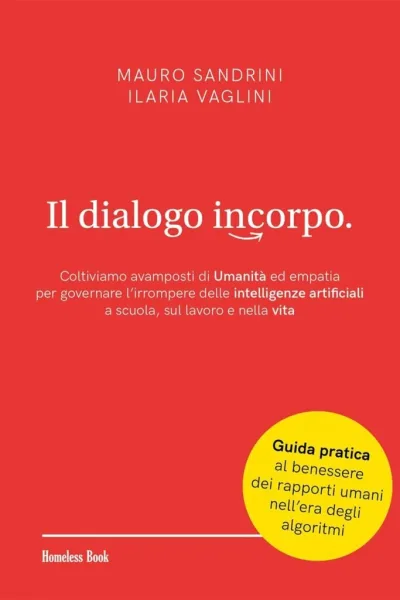
Further reading (in Italian)
Il dialogo incorpo
With Ilaria Vaglini, Homeless Book, 2024. A practical method to keep empathy and critical thinking alive while we use AI.